The Jazz Loft — music venue
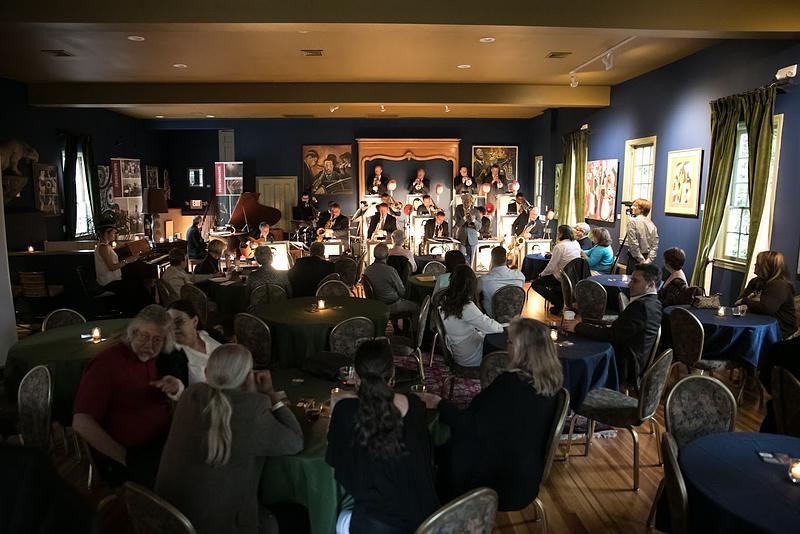
The Jazz Loft in Stony Brook has 56 upcoming shows. Next: Young at Heart: Ella Fitzgerald- Great Women in Jazz on Wed, Oct 7. Full calendar, lineups and tickets on Ckord.
The original use of this old building is not fully clear. Also known as the Stone Jug, it may have been a hoe or merely a storage facility for Jonas Smith. Later called Union Hall, over the years it served many purposes, including a general store, a tinsmith shop, and a factory for the manufacture of “lawn tennis shoes”. In 1886, a frame addition was constructed at the rear or west end of the building, greatly expanding its use, as it then faced two sides of the town triangle intersection. As late as 1941 the Odd Fellows hall was on its left and the Mills House on its right. Directly behind it once stood the garage to the Oakes-Dickerson House. In the early 1930s, O.C. Lempfert, avid hunter and taxidermist along with Dr. Winifred Curtis established a natural history museum comprised of hunting trophies and specimens which were displayed at friend Archie Rayner’s home. The neighborhood children were being brought to see this collection as early as 1935 on Saturdays and naturalist Robert Murphy o, of R.C. Murphy Jr. High School, led some of the nature walks. When the Rayner home was sold in 1939, Dr. Curtis appealed for help from Mrs. Ward Melville to find a new location for the collection. Persuaded by Mrs. Melville, the collection was moved to the empty building known as the Stone Jug, owned by local pharmacist Charles J. Zimmerlein. The Little Museum in the Jug as it came to be called, was formally incorporated as the Suffolk Museum on December 28, 1939 and the museum was quoted in regard to the move saying, “The move was no small task since by that time the collection include a 400-pound loggerhead turtle, an eagle with a 6-foot wingspread, a trumpeter swan, and hundreds of small collection items.” The original use of this old building is not fully clear. Also known as the Stone Jug, it may have been a hoe or merely a storage facility for Jonas Smith. Later called Union Hall, over the years it served many purposes, including a general store, a tinsmith shop, and a factory for the manufacture of “lawn tennis shoes”. In 1886, a frame addition was constructed at the rear or west end of the building, greatly expanding its use, as it then faced two sides of the town triangle intersection. As late as 1941 the Odd Fellows hall was on its left and the Mills House on its right. Directly behind it once stood the garage to the Oakes-Dickerson House. In the early 1930s, O.C. Lempfert, avid hunter and taxidermist along with Dr. Winifred Curtis established a natural history museum comprised of hunting trophies and specimens which were displayed at friend Archie Rayner’s home. The neighborhood children were being brought to see this collection as early as 1935 on Saturdays and naturalist Robert Murphy o, of R.C. Murphy Jr. High School, led some of the nature walks. When the Rayner home was sold in 1939, Dr. Curtis appealed for help from Mrs. Ward Melville to find a new location for the collection. Persuaded by Mrs. Melville, the collection was moved to the empty building known as the Stone Jug, owned by local pharmacist Charles J. Zimmerlein. The Little Museum in the Jug as it came to be called, was formally incorporated as the Suffolk Museum on December 28, 1939 and the museum was quoted in regard to the move saying, “The move was no small task since by that time the collection include a 400-pound loggerhead turtle, an eagle with a 6-foot wingspread, a trumpeter swan, and hundreds of small collection items.”
Address: 275 Christian Avenue, Stony Brook, New York 11790, United States
Phone: +1 (631) 751-1895
Upcoming shows at The Jazz Loft
- Young at Heart: Ella Fitzgerald- Great Women in Jazz — The Jazz Loft — Oct 7, 2026
- Jam Session - Hosted by The Frank Hanson Trio — The Jazz Loft — Oct 7, 2026
- Jam Session - Hosted by The Frank Hanson Trio — The Jazz Loft — Oct 14, 2026
- Monteleone: The Art of the Guitar Festival Opening Reception — The Jazz Loft — Oct 15, 2026
- Monteleone: The Art of the Guitar Festival - Ted Ludwig Trio: Ted Ludwig, guitar, Pat Bianci, organ, Steve Pruitt, drums — The Jazz Loft — Oct 16, 2026
- Monteleone: The Art of the Guitar Festival - The Tonebars — The Jazz Loft — Oct 17, 2026
- Monteleone: The Art of the Guitar Festival - Antoine Boyer & Yeore Kim — The Jazz Loft — Oct 17, 2026
- Jam Session - Hosted by The Frank Hanson Trio — The Jazz Loft — Oct 21, 2026
- Billy, Ella, and Beyond! Featuring vocalist Mala Waldron, along with Carl Safina and friends. — The Jazz Loft — Oct 22, 2026
- Carl Safina & Moments Notice Present “Ella, Billie & Beyond” — The Jazz Loft — Oct 22, 2026
Past shows at The Jazz Loft
- Sound of the Verse - Poetry/Jazz Event — The Jazz Loft — Oct 3, 2026
- Put Up Your Dukes! TJL Big Band Presents Duke Ellington — The Jazz Loft — Oct 2, 2026
- Put Up Your Dukes! TJL Big Band Presents Duke Ellington — The Jazz Loft — Oct 1, 2026
- Jam Session - Hosted by The Frank Hanson Trio — The Jazz Loft — Sep 30, 2026
- Cinema Jazz Series Presents: Anatomy Of A Murder (1959) — The Jazz Loft — Sep 26, 2026
- Interplay Jazz Orchestra — The Jazz Loft — Sep 24, 2026
- Jam Session - Hosted by The Frank Hanson Trio — The Jazz Loft — Sep 23, 2026
- 2026 Harbor Jazz Festival — The Jazz Loft — Sep 19, 2026
- Harbor Jazz Festival - Vijay Iyer Trio — The Jazz Loft — Sep 18, 2026
- Harbor Jazz Festival - Mike LeDonne Organ Trio — The Jazz Loft — Sep 17, 2026
Artists who have played The Jazz Loft
- Naama Gheber — 2 shows, last played 2026
- Vijay Iyer — 1 show, last played 2026
- Mike LeDonne — 1 show, last played 2026
- Mike LeDonne Organ — 1 show, last played 2026
- Noah Halpern — 1 show, last played 2026
- David Berkman — 1 show, last played 2024
- Aubrey Johnson — 1 show, last played 2024
- Miki Yamanaka — 1 show, last played 2024
- Jamile — 1 show, last played 2024
- Laura Anglade — 1 show, last played 2024
- Ben Rosenblum — 1 show, last played 2024